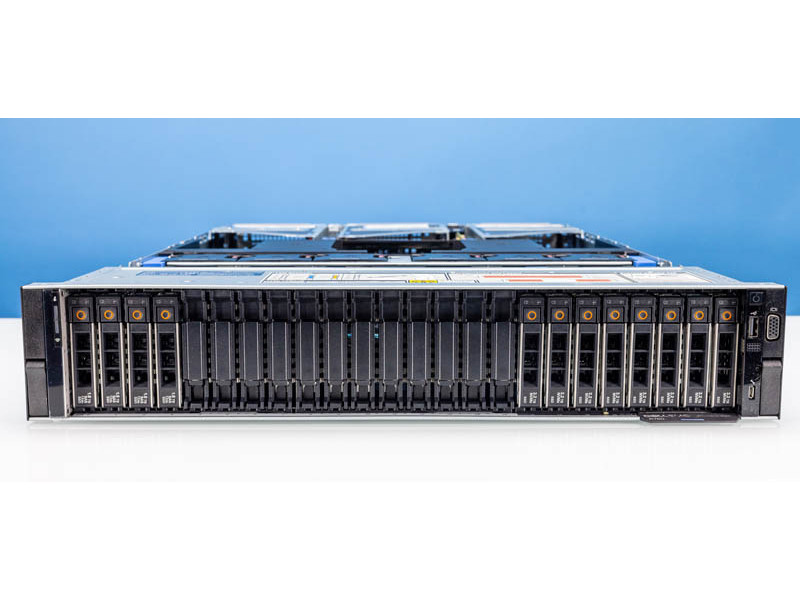
In short. The R760 is Dell's mainstream dual-socket 2U server: two Intel Xeon Scalable processors of the 4th or 5th generation, 32 DDR5 slots, PCIe 5.0, up to 24 × 2.5″ or 12 × 3.5″ bays and iDRAC9 management. It is the workhorse for virtualisation, databases and file storage — where 1U no longer fits the drives and the expansion cards. In the ITsmart catalogue the R760 8SFF is 38 677 000 UZS and the R760 12LFF with two Xeon Silver 4410Y and 32 GB is 78 000 000 UZS. The twofold gap is the second processor, the cage and the memory, not a premium for the badge.
All Dell PowerEdge configurations with prices →
Jump to: what is inside · cages: 8, 12, 16 or 24 · memory per channel · controller and boot · expansion cards and GPUs · R760 against R660 and R750 · catalogue prices · checklist · questions and answers
What is inside
- Processors. Two Intel Xeon Scalable of the 4th generation (Sapphire Rapids) or 5th (Emerald Rapids), up to 56 cores per socket at the top. The catalogue 12LFF build carries two Xeon Silver 4410Y — entry parts chosen for memory channels and PCIe lanes rather than for cores.
- Memory. 32 DDR5 slots, 16 per socket, eight channels per processor.
- Bus. PCIe 5.0, up to eight slots depending on risers, plus an OCP 3.0 slot for the network adapter.
- Drives. Cages for 8, 16 or 24 × 2.5″ or 12 × 3.5″; NVMe connects straight to the processors.
- Management. iDRAC9 with a dedicated port; remote console and virtual media are in the Enterprise licence.
Cages: the main decision at order time
- 12 × 3.5″ — capacity. Twelve 16–22 TB drives give well over a hundred terabytes in one chassis: file storage, archive, backup target. That is the R760 12LFF at 78 000 000 UZS.
- 8 × 2.5″ — the balanced build for SSD virtualisation: R760 8SFF at 38 677 000 UZS.
- 16 and 24 × 2.5″ — I/O density: databases, hyperconverged clusters, anything measured in operations per second rather than terabytes.
Count PCIe lanes to the drives rather than bays: a full x4 per NVMe device is not available in every backplane, and in dense cages some bays may be SAS and SATA only.
Memory: 32 slots and the eight-channel rule
Each processor has eight channels with two modules per channel. Full bandwidth needs sixteen modules — eight per socket. Four modules per processor leave half the channels empty and roughly halve memory throughput, and on a dual-socket machine that also distorts the NUMA picture: some virtual machines end up on the "slow" socket.
The catalogue build with 32 GB across two processors is a commissioning baseline, not a working capacity. Plan from 256 GB for virtualisation and from 512 GB for databases, populated as sixteen modules.
Controller and boot
RAID 5 and 6 with fast writes need a hardware controller with cache and power protection — a PERC H730 (5 750 588 UZS) on previous generations, a PERC H755 on current ones. Software-defined storage (vSAN, Ceph, Storage Spaces Direct) wants the opposite: a PERC H345 (4 312 941 UZS) or straight pass-through so the system can see drive health itself.
The hypervisor does not belong in the drive cage but on a Dell BOSS (7 907 058 UZS) — two mirrored NVMe M.2 drives as a separate boot volume. In 2U this is especially clear: giving two of twelve bays to the operating system is twenty lost terabytes.
Expansion cards and accelerators
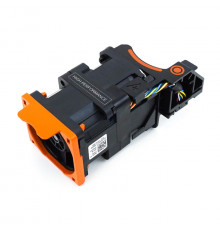
This is usually why 2U is chosen over 1U. Eight PCIe 5.0 slots take two FC HBAs, two 25G network cards and an external RAID controller at the same time — that set does not physically fit in 1U. Accelerators live here too: 2U accepts full-height double-width GPUs, but they require the high-performance fan kit and larger power supplies, both separate configurator items.
The network adapter belongs in the OCP 3.0 slot rather than a regular PCIe slot. What plugs into what is covered in our article on network cards and transceivers.
R760 against R660 and R750
| Model | Chassis | Xeon generation | When to take it |
|---|---|---|---|
| R760 | 2U | 4th and 5th | Drives, expansion slots or GPUs are needed; the general-purpose virtualisation choice |
| R660 | 1U | 4th and 5th | Rack density matters more than drive and card count |
| R750 | 2U | 3rd (Ice Lake) | Previous generation: DDR4 and PCIe 4.0, cheaper but without memory and bus headroom |
| R770 | 2U | Xeon 6 | The next generation with a modular design — when maximum cores per socket are needed |
The gap between R750 and R760 is not raw processor performance but the generation of memory and bus: DDR5 against DDR4, PCIe 5.0 against 4.0. For NVMe and 100G networking that matters; for a SATA file server it barely shows.
Catalogue prices, September 2026
| Configuration | Price |
|---|---|
| Dell PowerEdge R760 8SFF | 38 677 000 UZS |
| Dell PowerEdge R760 12LFF, 2 × Xeon Silver 4410Y, 32 GB | 78 000 000 UZS |
| PERC H730 with battery | 5 750 588 UZS |
| PERC H345 | 4 312 941 UZS |
| Dell BOSS, 2 × 480 GB NVMe | 7 907 058 UZS |
| Micron 7400 Pro 1.92 TB U.3 NVMe | 4 312 941 UZS |
| Intel D3-S4520 7.68 TB SATA SSD | 10 782 352 UZS |
Checklist before ordering
- The cage: 12 × 3.5″ for capacity, 8–24 × 2.5″ for speed. It cannot change after the build.
- Sixteen memory modules rather than four — are all channels of both processors populated.
- How many bays actually run as NVMe with full x4 lanes.
- A separate boot device instead of two drives from the cage.
- The high-performance fan kit and larger power supplies if GPUs or top processors are planned.
- An iDRAC9 Enterprise licence if the server is not in your own building.
We will build an R760 around the workload — the right cage, memory per channel, controller and networking — and say if an R660 or an R750 serves you better. Get in touch.
Questions and answers
How much does a Dell PowerEdge R760 cost in Tashkent?
The 8SFF build in the catalogue is 38 677 000 UZS and the 12LFF with two Xeon Silver 4410Y and 32 GB is 78 000 000 UZS. The final price depends on processors, memory, cage, drives and controller, and is quoted against a specific workload.
How does the R760 differ from the R750?
By platform generation: the R760 runs 4th and 5th generation Xeon Scalable with DDR5 and PCIe 5.0, the R750 the 3rd generation with DDR4 and PCIe 4.0. Chassis and cage logic are similar.
How many drives fit into an R760?
Depending on the cage, 8, 16 or 24 × 2.5″ drives or 12 × 3.5″. The cage is chosen at order time and changes only together with the backplane and cables.
Can a GPU be installed in an R760?
Yes, the 2U chassis accepts full-height double-width accelerators, but they need the high-performance fan kit and larger power supplies. Both go into the configuration up front, otherwise the server refuses the card or throttles.
How much memory for virtualisation?
From 256 GB as sixteen modules — eight per processor, so every channel is populated. The catalogue 32 GB across two sockets is a commissioning baseline.