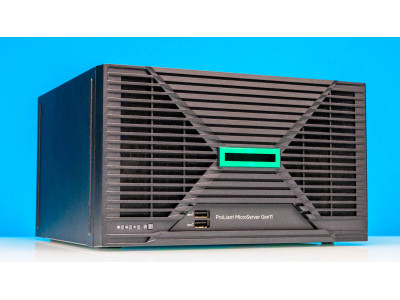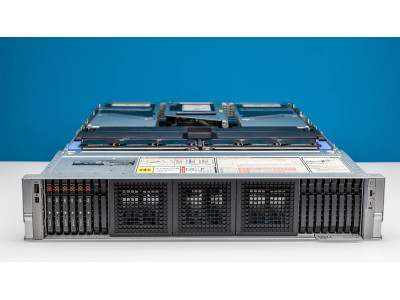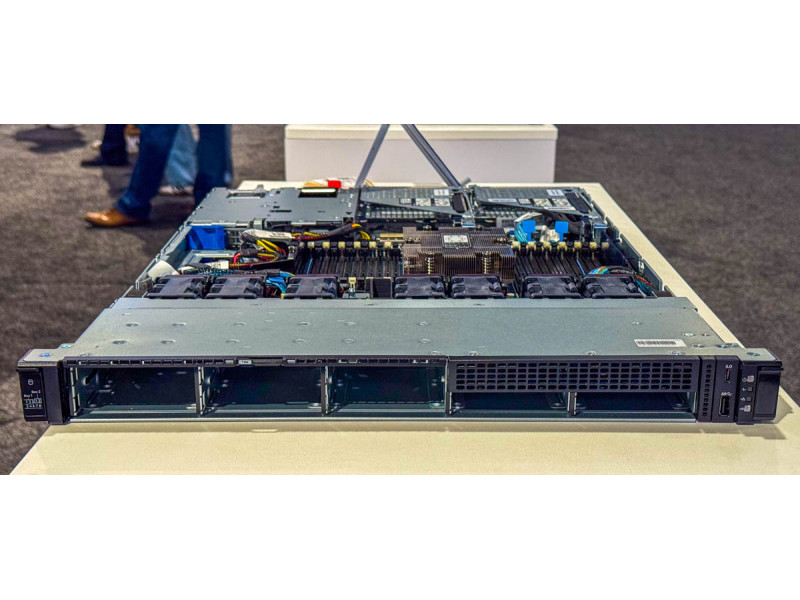
In short. The DL325 Gen12 and DL345 Gen12 are HPE's single-socket servers on AMD EPYC 9005: the DL325 in a 1U chassis, the DL345 in 2U with more drives and slots. The point of the range is that one EPYC socket delivers twelve memory channels and a core count that used to require two Intel processors — while virtualisation licences are still counted per socket and per core. Neither model is in the ITsmart catalogue yet; the closest single-socket machine in stock is the Intel-based HPE ProLiant DL320 Gen11 at 41 000 000 UZS.
All HPE ProLiant configurations with prices →
Jump to: what these machines are · EPYC 9005: cores and channels · why a single socket · DL325 or DL345 · what is available now · questions and answers
What these machines are
HPE moved the Gen12 generation to AMD EPYC 9005 (codename Turin) and kept the naming logic: the DL325 is a single-socket 1U, the DL345 a single-socket 2U. The difference between them is the usual 1U versus 2U trade: the second has more drive bays, more expansion slots and room for an accelerator.
What matters is that both are single-socket machines. This is not a cut-down version of a dual-socket platform but a deliberate class: one modern EPYC covers the workload that took a pair of processors five years ago.
EPYC 9005: cores and channels
- Cores. The top parts give noticeably more cores per socket than any single-socket Intel. For container and multi-threaded workloads that is a direct win.
- Memory. Twelve DDR5 channels per socket against eight on Xeon. The "fill channels, not slots" rule is stricter here: reaching the rated bandwidth takes twelve modules.
- PCIe lanes. EPYC traditionally offers more of them than a single-socket Xeon, so a 1U chassis fits more NVMe drives with full x4 lanes instead of splitting the bandwidth.
The flip side is the thermal envelope. Top EPYC 9005 parts run hot enough that a 1U chassis needs the high-performance cooling kit and sometimes a liquid loop. In such builds the fan kit is a mandatory line item, not an option.
Why a single socket is not a compromise
The argument is the same as for single-socket Intel, only stronger. VMware's licensing floor is 16 cores per physical processor: two weak CPUs in a dual-socket machine are billed as 32 cores, one strong CPU as 16. Windows Server is licensed from 16 cores per server and no fewer than 8 per processor.
The second argument is NUMA. A single-socket system has one memory node, and a large virtual machine cannot end up split across processors — the usual explanation for erratic database and 1C performance on dual-socket servers where nobody watched VM sizing. The full reasoning is in our DL320 Gen11 review.
When two sockets are still required: more memory than one socket holds; a corporate standard demanding processor-level redundancy; several expansion cards at once — two FC HBAs, two 25G NICs and an external RAID controller.
DL325 or DL345
| Model | Chassis | Sockets | When to take it |
|---|---|---|---|
| DL325 Gen12 | 1U | 1 | Rack density, a virtualisation node, an edge site |
| DL345 Gen12 | 2U | 1 | Drives, expansion slots or an accelerator on a single processor |
| DL385 Gen12 | 2U | 2 | Two EPYC sockets: maximum cores and memory in one system |
The practical rule: if you are counting drives and slots, take 2U; if you are counting rack units, take 1U. The processor base of the DL325 and DL345 is identical, so the chassis choice does not change performance.
What is available now
Gen12 on EPYC is supplied to order, with lead time and price on request. From stock, the same jobs are covered by:
| Model | Class | Price |
|---|---|---|
| HPE ProLiant DL320 Gen11 | single-socket 1U on Intel Xeon Scalable | 41 000 000 UZS |
| HPE ProLiant DL360 Gen11 | dual-socket 1U | 40 000 000 UZS |
| HPE ProLiant DL380 Gen11 | dual-socket 2U for drives and cards | 49 000 000 UZS |
| Dell PowerEdge R760 | dual-socket 2U, the Dell alternative | 38 677 000 UZS |
We will size the configuration and compare total cost including licences — more often than not that, rather than hardware price, settles the one-socket versus two-socket argument. Get in touch.
Questions and answers
How does the DL325 Gen12 differ from the DL345 Gen12?
Only by chassis and what follows from it: the DL325 is 1U, the DL345 is 2U with more drive bays, more expansion slots and room for an accelerator. Both run the same single-socket AMD EPYC 9005.
How many memory channels does EPYC 9005 have?
Twelve per socket against eight on Intel Xeon Scalable. To reach the rated bandwidth all twelve must be populated: a build with eight modules leaves a third of the channels empty.
Are the DL325 or DL345 Gen12 available in Tashkent?
Not in the ITsmart catalogue yet — supplied to order. The closest single-socket machine in stock is the Intel-based DL320 Gen11 at 41 000 000 UZS.
Is one EPYC cheaper than two Xeons?
On licences, almost always yes, because the minimums are counted per physical processor. On hardware it depends on the part: top EPYC models are expensive. Cost it in total, including memory (twelve modules rather than eight) and licences over the full term.
Is the high-performance fan kit required?
For top EPYC 9005 parts in a 1U chassis, yes — it is a mandatory order line. Skip it and the server throttles under load or refuses the chosen processor.