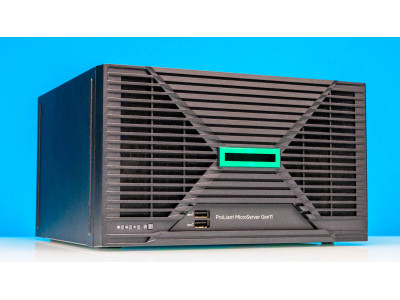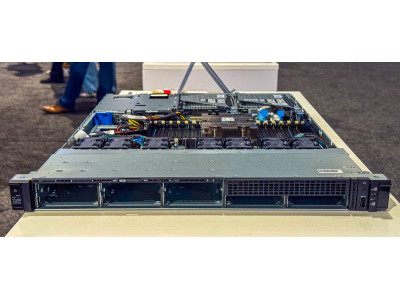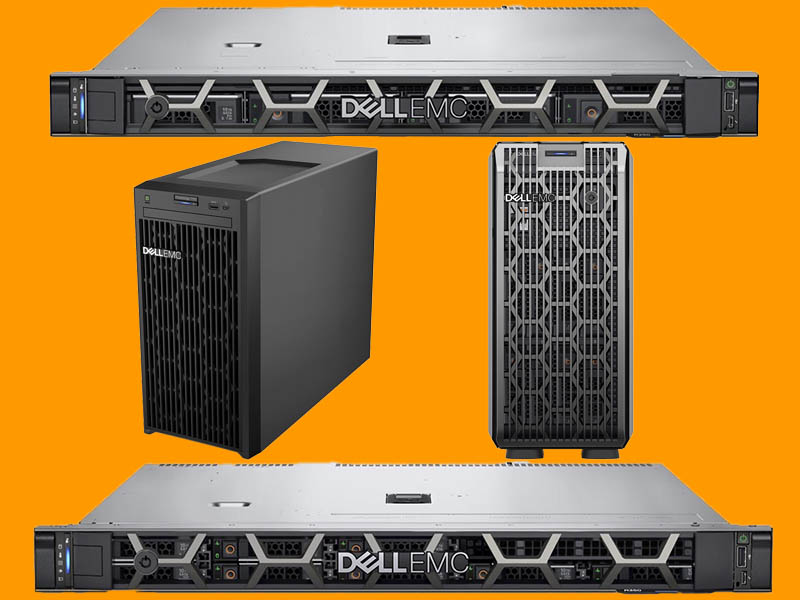
In short. The four entry-level PowerEdge models differ in two things: chassis (T for tower, R for rack) and drive bay count. The T150 is a tower with four 3.5″ bays from 13 808 000 UZS, the T350 a tower with eight from 25 799 000 UZS, the R250 a 1U rack unit with four from 20 500 000 UZS, and the R350 a 1U with eight 2.5″ bays from 20 542 000 UZS. All four run a single Intel Xeon E with up to eight cores and up to 128 GB of ECC memory. The real trap is not the model choice but the RAID controller and the absence of hot-swap in entry builds.
All Dell PowerEdge configurations with prices → — from the entry T150 to dual-socket R760s, with availability and lead times.
Jump to: the difference in one table · tower or rack · drives: 3.5″ or 2.5″ · processor and memory · controller and hot-swap · catalogue prices · checklist · questions and answers
The difference in one table
| Model | Chassis | Bays | Drive format | From |
|---|---|---|---|---|
| PowerEdge T150 | tower | 4 | 3.5″ LFF | 13 808 000 UZS |
| PowerEdge T350 | tower | 8 | 3.5″ LFF | 25 799 000 UZS |
| PowerEdge R250 | 1U rack | 4 | 3.5″ LFF | 20 500 000 UZS |
| PowerEdge R350 | 1U rack | 8 | 2.5″ SFF | 20 542 000 UZS |
Everything else — the processor base, memory, networking, iDRAC management — is shared. So the choice comes down to two questions: is there a rack, and how many drives do you need.
Tower or rack
This is a question about the room, not about taste. A tower stands on the floor of a utility room or an office: quieter, no rack or mounting required, easy to move. A 1U rack unit assumes the rack already exists — otherwise the server ends up lying on a shelf and the airflow design stops working.
Noise is the underrated factor. In 1U the fans are small and fast because cooling has to happen through 44 mm of height. A tower removes the same heat with large slow fans. If the server shares a room with people, a tower is the only option that will not turn into complaints within a week.
Drives: four or eight, 3.5″ or 2.5″
- Four 3.5″ bays (T150, R250). Maximum capacity for minimum money: four 8–16 TB drives give tens of terabytes. But RAID 6 across four drives spends half the capacity on parity, and RAID 5 on drives that size is a bad idea — the reasoning is in our RAID and disk subsystem guide.
- Eight 3.5″ bays (T350). Same principle with twice the headroom: RAID 6 across eight drives loses only a quarter of the capacity to parity.
- Eight 2.5″ bays (R350). The format for SAS and SATA SSDs. Less capacity per drive, but several times more random operations per second — a database and 1C configuration, not a file archive one.
The practical rule: storage-led workloads take 3.5″, database and virtualisation workloads take 2.5″ with SSDs. These chassis do not offer a mixed layout.
Processor and memory: where the line ends
All four models are built on the Intel Xeon E — a single-socket platform with up to eight cores and up to 128 GB of memory. Three processors appear in the catalogue: the E-2314 (4 cores, entry), the E-2324G (4 cores, higher clocks) and the E-2334 (4 cores, higher clocks and more cache).
That defines the main limit of the range. Eight cores and 128 GB is the ceiling, not the starting point: five or six virtual machines fit comfortably, twenty do not. If the sizing calls for more memory or cores, the answer is not a loaded T350 but the next class — the dual-socket PowerEdge R760 at 38 677 000 UZS.
The memory is ECC, and that is not marketing: in a server that runs for years without a reboot, single-bit errors happen regularly, and ECC turns them into log entries instead of corrupted data. Buy the memory up front: a T150 with 128 GB is 20 500 000 UZS against 13 808 000 UZS for the entry build — less than adding modules one at a time later.
Controller and hot-swap — where people get caught
The RAID controller. In the base build the drives may be handled by a software controller on the chipset. It works, but it has no write cache, depends on the operating system driver and travels badly if the array has to move to another server. Production workloads want hardware: a PERC H345 (4 312 941 UZS) for simple volumes and HBA mode, or a PERC H730 with cache and battery (5 750 588 UZS) if you need RAID 5 or 6 with fast writes.
Hot-swap. Entry T150 and R250 builds ship with cabled drives and no backplane — replacing one means powering the server down. That is fine for a server in the next room and unacceptable for a branch in another city. Confirm the backplane at order time: from the outside the chassis look identical.
Boot. Spending two of four bays on a hypervisor is wasteful. The answer is the Dell BOSS (7 907 058 UZS), a card with two mirrored NVMe M.2 drives that the system sees as one boot volume.
Catalogue prices, September 2026
| Configuration | Price |
|---|---|
| T150 4LFF, Xeon E-2314, 8 GB | 13 808 000 UZS |
| T150 4LFF, Xeon E-2334, 32 GB | 17 012 000 UZS |
| T150 4LFF, Xeon E-2334, 128 GB | 20 500 000 UZS |
| R250 4LFF, Xeon E-2314, 8 GB | 20 500 000 UZS |
| R250 4LFF, Xeon E-2334, 32 GB | 24 261 000 UZS |
| R350 8SFF, Xeon E-2324G, 16 GB | 20 542 000 UZS |
| R350 8SFF, Xeon E-2334, 16 GB | 22 500 000 UZS |
| T350 8LFF, Xeon E-2314, 8 GB | 25 799 000 UZS |
| T350 8LFF, Xeon E-2334, 16 GB | 27 500 000 UZS |
| PERC H345 RAID controller | 4 312 941 UZS |
| PERC H730 with battery | 5 750 588 UZS |
| Dell BOSS, 2 × 480 GB NVMe | 7 907 058 UZS |
The spread within one model is processor and memory: a T150 runs from 13 808 000 UZS with the entry Xeon and 8 GB to 20 500 000 UZS with 128 GB.
Checklist before ordering
- Is there a rack. No rack means a tower, with no alternatives.
- How many drives are needed over the service life: four or eight. This cannot be changed later.
- 3.5″ for capacity or 2.5″ for speed — decided by workload, not by price.
- Whether the chosen build includes a hot-swap backplane.
- A hardware RAID controller with cache protection if RAID 5 or 6 is required.
- A separate boot device so the hypervisor does not occupy drive bays.
- A second power supply: entry builds often ship with one.
- The iDRAC licence tier — remote console is Enterprise only.
We will size the configuration for the job and say plainly if the entry range will not be enough. Get in touch; all PowerEdge configurations with prices are here.
Questions and answers
How does the T150 differ from the T350?
Drive bays and power headroom: four 3.5″ bays on the T150, eight on the T350, whose chassis is rated for a larger thermal envelope. Both use the Intel Xeon E platform. If four drives will last the service life, there is no reason to pay for a T350.
How does the R250 differ from the R350?
Drive format: the R250 takes four 3.5″ drives for capacity, the R350 eight 2.5″ drives for speed. Both are 1U rack units on a single Xeon E. The R350 is bought for databases and 1C, the R250 for file serving and backups.
How much does a Dell PowerEdge T150 cost in Tashkent?
From 13 808 000 UZS for a Xeon E-2314 with 8 GB up to 20 500 000 UZS with 128 GB. The price depends on the processor, memory, drives and whether a hardware RAID controller is included.
Can drives be swapped hot?
It depends on the build. Entry configurations ship with cabled drives and no backplane, so replacement requires a shutdown. Hot-swap is available in backplane configurations and is a separate line item worth confirming in advance.
Is an entry PowerEdge enough for virtualisation?
For five or six small virtual machines, yes, given SSDs and 64–128 GB of memory. The ceiling of the range is eight cores and 128 GB, and it is memory, not CPU, that runs out first at around ten machines.
What to take if more memory and cores are needed?
The next class: the dual-socket PowerEdge R760 from 38 677 000 UZS. Dell has nothing between Xeon E and Xeon Scalable, so the step up is a jump rather than a gradient.