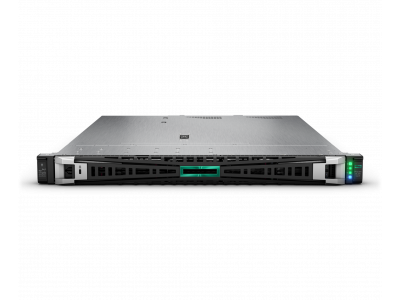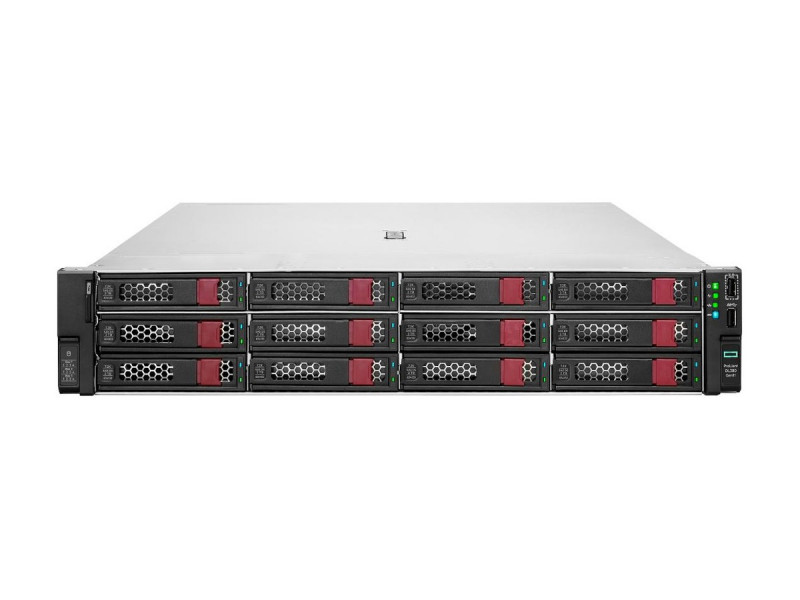
In short. The HPE ProLiant DL380 Gen11 is a general-purpose dual-socket 2U on 4th and 5th generation Xeon Scalable: 32 DDR5 slots, PCIe Gen5, up to 24 SFF bays with NVMe support and iLO 6. In the ITsmart catalogue ready Gen11 builds start at 35,537,000 UZS (8LFF, 16SFF and 24SFF) and 35,655,000 UZS for the 8SFF version, with the bare platform at 49,000,000 UZS (September 2026). For a single-service workload the platform is excessive: a DL320 Gen11 at 41,000,000 UZS or a DL360 Gen11 at 40,000,000 UZS costs less.
Size a server online → — three steps, an indicative price and an exact quote from a manager within one business day.
The HPE ProLiant DL380 Gen11 is a dual-processor 2U server and the workhorse of enterprise infrastructure. It is the most universal platform in the ProLiant line, equally at home under virtualisation, databases, file services and hyper-converged cluster nodes. Here is what changed in the eleventh generation, how to build a configuration and who should buy it.
What is new against Gen10
- Intel Xeon Scalable processors of the 4th and 5th generations (Sapphire Rapids and Emerald Rapids) replace Cascade Lake and Ice Lake. Core counts per socket rose noticeably and built-in accelerators appeared (QAT, DSA, IAA).
- DDR5 memory instead of DDR4 — higher bandwidth per channel and eight channels per socket against six on some earlier models. For virtualisation and analytics that is tangible; module population is covered in our server memory guide.
- PCIe Gen5 — twice the bandwidth per lane, which starts to matter with 100 or 200GbE adapters and current-generation NVMe drives.
- iLO 6 with a hardened security model: silicon root of trust, firmware integrity checks and support for secure boot requirements.
The main consequence: memory and processors from older machines do not move to Gen11. What carries over on a generation change and what has to be bought again is covered in upgrading the server fleet.
Configuration options
| Parameter | Practical reference |
|---|---|
| Processors | 1 or 2 sockets, Xeon Scalable 4th/5th generation, up to 64 cores per socket |
| Memory | 32 DDR5 RDIMM slots, eight channels per processor |
| Storage | SFF bays: 8 / 16 / 24 with SAS, SATA and NVMe; an 8LFF option for capacity |
| Controllers | HPE MR and NS series in RAID or HBA mode; NVMe needs tri-mode |
| Networking | OCP 3.0 plus PCIe slots, from 1GbE to 100GbE |
| Power | redundant Flexible Slot supplies, titanium efficiency |
Ready builds from the catalogue
- DL380 Gen11 8SFF — 35,655,000 UZS. A compact eight-bay cage: a cluster node when data lives on external storage.
- DL380 Gen11 16SFF and DL380 Gen11 24SFF — 35,537,000 UZS each. Dense drive configurations for local storage, hyper-convergence and NVMe databases.
- DL380 Gen11 8LFF — 35,537,000 UZS. A 3.5-inch cage: file server, backup repository, video surveillance.
- DL380 Gen11 as a bare platform — 49,000,000 UZS, configured with processors, memory and drives for the task.
The full list with prices is in the HPE ProLiant Gen11 guide, and drives and controllers for it in drives and RAID controllers.
Which workloads to buy it for
Virtualisation. The main scenario. Two high-core sockets and 32 DDR5 slots give consolidation headroom: dozens of virtual machines fit on one node. Size a cluster with an N+1 reserve and check the core count against licensing minimums — VMware counts 16 cores per processor.
Databases. DDR5 and NVMe bandwidth shape response time directly. For a busy database use NVMe bays and populate every memory channel; under-filled channels cut performance more than people expect.
Hyper-convergence and software-defined storage. The DL380 Gen11 is a standard node. Here the controller must run in HBA (pass-through) mode: Ceph, vSAN and ZFS manage redundancy themselves.
File servers and backup. Often excessive: a DL360 Gen11 or DL320 Gen11 saves on chassis and licences without losing needed functionality. The 1U versus 2U question is covered separately.
What to check when ordering
- Memory channels. Populate modules symmetrically across every channel of both processors.
- Backplane. The cage type is fixed at order time; converting SAS/SATA to NVMe later means a new backplane and cabling.
- Thermal envelope. Top processors need high-performance cooling and different fans, which also affects rack power — the facility checklist is in a server room in the office.
- Network adapter. Filling the OCP slot leaves PCIe slots free for GPUs or controllers; which cards and transceivers fit is covered here.
- The iLO Advanced licence. Remote graphical console and virtual media are licensed separately and bought with the server.
Gen10 Plus, Gen11 or Gen12
The previous generation is also stocked: a DL380 Gen10 Plus 8SFF at 43,263,000 UZS is a mature DDR4 and PCIe Gen4 platform, sensible for expanding an existing fleet where node uniformity matters. Gen12 on Xeon 6 earns its place where very high core density, EDSFF drives or a long lifecycle are required. For mid-market virtualisation, Gen11 remains the balance point between price and capability.
Summary
The DL380 Gen11 is the default choice when a universal dual-socket server with a long service horizon is needed. For a narrow single-service task the platform is excessive and a DL320 Gen11 or DL360 Gen11 makes more sense.
To size a configuration and cost it with licences, write to us. We supply new and refurbished hardware — when the second option is justified is covered separately.
Questions and answers
How much does an HPE ProLiant DL380 Gen11 cost in Tashkent?
Ready builds start at 35,537,000 UZS for the 8LFF, 16SFF and 24SFF configurations and 35,655,000 UZS for 8SFF; the bare platform is 49,000,000 UZS. The final price depends on processors, memory and drives, so the configuration is costed for the specific workload.
Can memory and processors be reused from a Gen10?
No. Gen10 runs DDR4 on socket LGA3647 while Gen11 runs DDR5 on LGA4677. Usually only SAS and SATA drives travel — with new carriers — along with expansion cards that appear in the compatibility list.
How does the DL380 Gen11 differ from the DL360 Gen11?
Processors, memory and chipset are identical; the difference is chassis height, 2U against 1U. The DL380 offers up to 24 SFF bays, more PCIe slots and room for full-height GPUs; the DL360 is denser in the rack and cheaper where data lives on external storage.
Do I need a RAID controller or is an HBA enough?
Classic virtualisation on local drives takes a controller with cache and a battery. Software-defined storage — Ceph, vSAN, ZFS — needs HBA mode with direct drive access, where hardware RAID gets in the way. NVMe configurations require a tri-mode controller.